Fort Lauderdale, known as the 'Venice of America' due to its expansive and intricate canal system, is a city in Broward County, Florida, United States. Some of the things the city is known for are its sandy beaches, trendy bars, and chic nightclubs. The city's population is described as metropolitan, where diverse culture is commonplace. According to the 2004 U.S. Census Bureau's Estimates, the city had a population of 164,578. Annexation of unincorporated areas in 2005 has boosted the city population to 170,823. It is the county seat of Broward County, and forms a part of the South Florida metropolitan area.
GovernmentFort Lauderdale has a Commission-Manager form of government. City policy is set by a city commission of five elected members; the mayor and four district commission members. Administrative functions are performed by a City manager, who is appointed by the city commission. Fire & EMS Services are provided by Fort Lauderdale Fire-Rescue Department
Mayors of Fort LauderdaleThe mayor of Fort Lauderdale serves a three-year term, no greater than six consecutive terms, for a total of eighteen years. The current and longest-ever serving mayor, Jim Naugle, will be ineligible for reelection in 2009.
Mayor was appointed from the Council.
Mayor was appointed from the Commission for a two year term
Mayor is elected in city-wide race, serving a three year terms (not to exceed 6 terms)
Fort Lauderdale is located at 26°08′09″N, 80°08′31″W (26.135763, -80.141810).GR1
According to the United States Census Bureau, the city has a total area of 93.3 km˛ (36.0 mi˛). 82.2 km˛ (31.7 mi˛) of it is land and 11.1 km˛ (4.3 mi˛) of it (11.91%) is water. Fort Lauderdale is known for its extensive network of canals, and is an especially popular destination for fishing and yachting.
The city of Fort Lauderdale is adjacent to the Atlantic Ocean, includes several miles of beachfront, and borders the following municipalities:
On its east:
On its south:
The northwesternmost section of Fort Lauderdale is separate from the remainder of the city, except for the Cypress Creek Canal as it flows under I-95. This section of Fort Lauderdale borders the cities of Tamarac and Oakland Park on its south side.
Oakland Park also borders Fort Lauderdale on the west side of its northeastern portion. The greater portion of Fort Lauderdale in the south is bordered, along its north side by Wilton Manors.
Off the coast of Fort Lauderdale is the Osborne Reef, an artificial reef made of discarded tires that has proven an ecological disaster.[1]
EconomyFort Lauderdale's economy is heavily reliant on tourism. During the 1970s, the city was known as a spring break destination for college students. The tourist dollars are largely directed toward cruise ships and the array of nautical recreation. Fort Lauderdale now attracts a more sophisticated and affluent tourist[2], however it still remains a popular spring break destination for college students.
The entertainment district runs east-west along Las Olas Boulevard, from the beach to the heart of downtown. The district is anchored in the West by the Broward Center for the Performing Arts, and runs through the city to arrive at the intersection of Las Olas and A1A. This intersection is the 'ground zero' of Fort Lauderdale Beach, and is the site of the 'Elbo Room' bar featured in the 1960 film Where the Boys Are, which led in large measure to the city's former reputation as a spring break mecca. The city also hosts Langerado, an annual music festival.
Fort Lauderdale is a major manufacturing and maintenance center for yachts. The boating industry is responsible for over 100,000 jobs in the area. With its many canals, and proximity to the Bahamas and Caribbean, it is also a popular yachting vacation stop. The boating industry is in transition as high land cost are forcing marinas to sell and relocate out of the area. Addtionally, the number of boat slips are declining as marinas are more actively seeking the large mega-yachts.
The downtown area, especially around Las Olas Boulevard, has seen dramatic growth in the past decade, and now hosts many new hotels and high-rise condominium developments. Other improvements include a wide array of new boutiques, art galleries, and restaurants as well as upgrades to Lockhart Stadium (to attract marquee sporting events).
Several large companies are based in the Fort Lauderdale area including: AutoNation USA, Citrix Systems, DHL Express, Spirit Airlines, and National Beverage Corp. Due to its proximity to Miami, Fort Lauderdale is emerging as a location for Latin American headquarters for companies such as Microsoft.
TransportationLocal transportation includes Broward County Transit (BCT), the county bus system. BCT provides for connections with the bus systems in other parts of the metropolitan area: Metrobus in Miami-Dade County and Palm Tran in Palm Beach County. Tri-Rail, a commuter rail system, connects the major cities and airports of South Florida. In November 2006, Broward County voters rejected a one-cent-per-hundred sales tax increase intended to fund transportation projects such as light rail and expanding the bus system.
Several railroads pass through Fort Lauderdale. Florida East Coast Railroad (FEC) and CSX Systems are freight lines. Amtrak provides passenger service to other cities on the Atlantic coast, and Tri-Rail provides commuter service from Palm Beach County, through Broward County/Fort Lauderdale, and into Miami-Dade County.
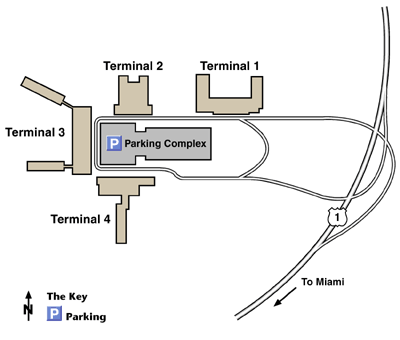
Fort Lauderdale-Hollywood International Airport is the city's main airport and is one of the fastest growing airports in the country. Fort Lauderdale-Hollywood is an emerging international gateway for the Caribbean and Latin America. Fort Lauderdale is also served by Miami International Airport and Palm Beach International Airport.
Fort Lauderdale is also home to one of the ten largest general aviation airports in the country, Fort Lauderdale Executive Airport.
Fort Lauderdale is served by Port Everglades, the nation's 2nd busiest cruise port. It is Florida's deepest port, and is an integral petroleum receiving point.
Broward County is served by three major Interstates (I-75, I-95, I-595) and some U.S. Highways including U.S. Route 1, US 27 and US 441. It is also served by Florida's Turnpike and State Highway 869, also known as the Sawgrass Expressway.
SportsSeveral institutions of higher learning that have main or satellite campuses located within the city of Fort Lauderdale are:
Fort Lauderdale's public education is served by Broward County Public Schools. Public high schools that are within the city of Fort Lauderdale are:
A few private schools located within the city of Fort Lauderdale are:
Fort Lauderdale is served by Broward General Medical Center, which is operated by the North Broward Hospital District, the third largest hospital consortium in the United States. Broward General is a 716-bed acute care facility which is designated as a Level 1 trauma center. It is also home to Chris Evert Children's Hospital and a Heart Center of Excellence, which were recently expanded as part of a $160 million dollar renovation. The hospital serves as a major training site for medical students from Nova Southeastern University's College of Osteopathic Medicine, as well as nursing and paramedic programs from throughout the area.
DemographicsAs of the censusGR2 of 2000, there were 152,397 people, 68,468 households, and 33,001 families residing in the city. The population density was 1,854.4/km˛ (4,803.1/mi˛). There were 80,862 housing units at an average density of 984.0/km˛ (2,548.5/mi˛). The racial makeup of the city was 64.27% White, 28.88% African American, 0.23% Native American, 1.03% Asian, 0.05% Pacific Islander, 1.76% from other races, and 3.79% from two or more races. Hispanic or Latino of any race were 9.45% of the population.
There were 68,468 households out of which 19.6% had children under the age of 18 living with them, 32.2% were married couples living together, 11.5% had a female householder with no husband present, and 51.8% were non-families. 40.3% of all households were made up of individuals and 11.7% had someone living alone who was 65 years of age or older. The average household size was 2.14 and the average family size was 2.97.
In the city the population was spread out with 19.4% under the age of 18, 7.7% from 18 to 24, 32.8% from 25 to 44, 24.8% from 45 to 64, and 15.3% who were 65 years of age or older. The median age was 39 years. For every 100 females there were 110.0 males. For every 100 females age 18 and over, there were 111.1 males.
The median income for a household in the city was $37,887, and the median income for a family was $46,175. Males had a median income of $34,478 versus $27,230 for females. The per capita income for the city was $27,798. About 13.8% of families and 17.7% of the population were below the poverty line, including 29.0% of those under age 18 and 11.1% of those age 65 or over.
Neighborhoods/CommunitiesAccording to the Greater Fort Lauderdale Convention and Visitor's Bureau, Fort Lauderdale is 'America's top gay resort area.'
Sister CitiesFort Lauderdale has 15 sister cities, as designated by Sister Cities International, Inc. (SCI):
MediaFort Lauderdale is served by two English-language newspapers, the South Florida-Sun Sentinel and The Miami Herald, as well as two Spanish-language newspapers El Sentinel and El Nuevo Herald.
Fort Lauderdale is a part of the Miami media market, which is the 12th largest radio market and the 17th largest television market in the United States. Television stations serving the Miami area include WAMI (Telefutura), WBFS (My Network TV), WBZL (The CW), WFOR (CBS), WHFT (TBN), WLTV (Univision), WPLG (ABC), WPXM (i), WSCV (Telemundo), WSVN (FOX), WTVJ (NBC), WPBT (PBS), and WLRN (also PBS).